Nobel laureate Fred Ramsdell returns to UCLA
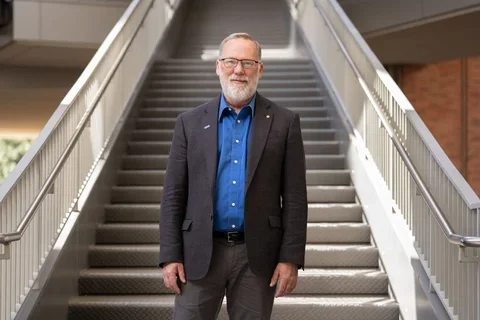
A crowd filed through the glass doors of the California NanoSystems Institute at UCLA last Friday, stealing glances through the lobby windows into the courtyard where UCLA Chancellor Julio Frenk stood with Frederick J. “Fred” Ramsdell. As attendees entered the auditorium, Frenk reached for his UCLA lapel pin.
In an unscripted gesture, he removed it from his own suit jacket and fastened it onto Ramsdell’s lapel, marking a symbolic welcome home to the UCLA alumnus and 2025 Nobel Prize laureate in physiology or medicine.
Minutes later, Ramsdell, who earned his doctorate in microbiology and immunology from UCLA in 1987, mentioned the exchange from the podium before a capacity crowd and overflow audience in the lobby watching on livestream. The quiet outside exchange sharply contrasted with the packed house inside, a private gesture that initiated the public celebration of shared history and scientific purpose.
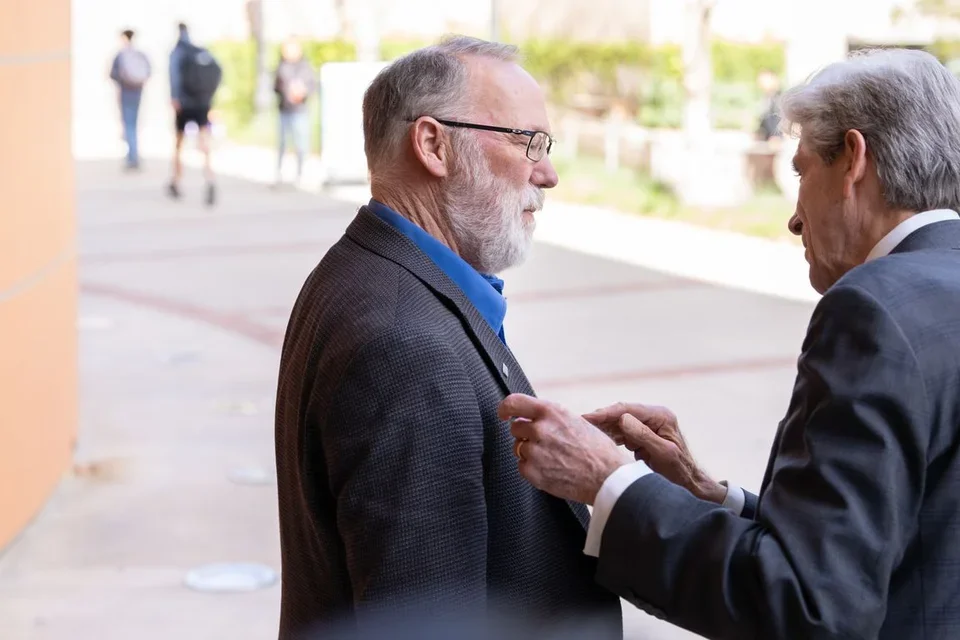
Photo Credit: David Esquivel/UCLA
A foundation built at UCLA
The seminar, “From the Manhattan Project to Autoimmune Therapy,” brought together faculty, students, alumni and community members eager to hear from the Bruin about his groundbreaking work on regulatory T cells (T-regs) that has opened new therapeutic pathways in areas like cancer, autoimmune disease and stem cell transplantation. It was hosted by the UCLA College’s department of microbiology, immunology and molecular genetics and the David Geffen School of Medicine at UCLA.
“Today is really a very special day for UCLA, because we are privileged to welcome Fred Ramsdell back to his alma mater,” Frenk said in his opening remarks. “This is your home. We’re immensely proud of you.”
He also pointed to Ramsdell’s work as an example of what comprehensive research universities aim to do. “Research powers progress,” Frenk said. “Knowledge is the most powerful force to enlighten social transformation.”
Hector Aguilar-Carreno, the Sherie L. Morrison Legacy Department Chair in Microbiology, Immunology and Molecular Genetics, added: “It is a rare honor to introduce a speaker whose work has quite literally rewritten the textbook of modern immunology.”
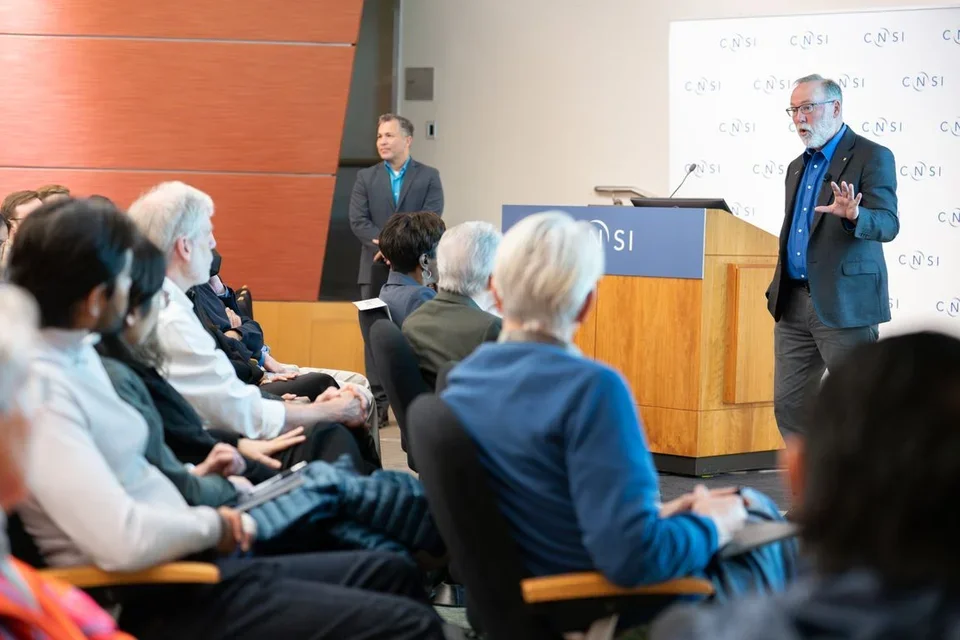
Photo Credit: David Esquivel/UCLA
Ramsdell, who shared the Nobel Prize with Mary Brunkow and Shimon Sakaguchi for discoveries revealing how regulatory T cells prevent the immune system from attacking the body’s own tissues, framed his return with gratitude.
“When I got to the [National Institutes of Health], which was probably the center of the world for immunology research in the late ’80s, I realized that I actually knew what I was doing. I was actually well trained,” he said. “A lot of my ability to succeed, I think, started here.”
He traced his scientific journey, beginning with early genetic research involving the “scurfy” mouse line, which was first identified decades earlier at Oak Ridge National Laboratory as a lab-bred lineage carrying a spontaneous mutation. In 2001, Ramsdell and Brunkow discovered that a mutation in the gene they named Foxp3 left these mice vulnerable to fatal autoimmune disease, which ultimately led to the development of therapies to restore immune balance in patients with autoimmune conditions.
Inspiring the next generation
The seminar also highlighted the connection between Ramsdell’s achievements and the UCLA community that helped shape them, from faculty mentors to students in laboratories and lecture halls.
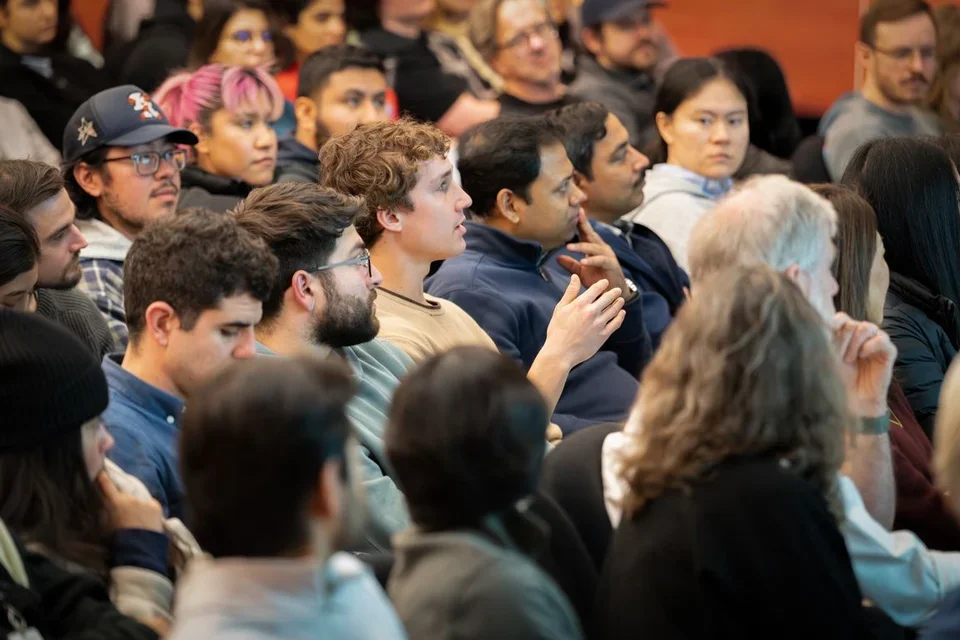
Photo credit: David Esquivel/UCLA
The moment resonated with students and trainees in the room.
Zoë Chan, a master’s student in bioengineering who first encountered Ramsdell when he dropped into an undergraduate lecture she attended the day before, said she was struck by his discussion in that class and eager to hear more. “I was very impressed by his confidence in his research throughout the journey,” Chan said after the seminar. “I think that’s something that I appreciate, as oftentimes research can have its ups and downs.”
Jigisha Hota, a UCLA alum now pursuing a master’s in engineering and translational medicine, was drawn to the event by the significance of the award. “I came to hear the lecture because he has a Nobel Prize — and a Nobel is a big deal,” she said with a laugh.
Hota, who hopes to pursue her doctoral degree at UCLA, said she left the seminar with a deeper appreciation for the historical arc of the research. “I knew about T-regs, but I didn’t know about the whole history,” she said. “So it was really nice that he walked us through the whole chronology of how he made his discovery. A lot of new concepts.”
The sense of continuity, from foundational research to modern therapeutic innovation, echoed throughout the afternoon. Ramsdell emphasized that scientific progress is rarely linear and often collaborative, as he reflected on his decision to pursue biotechnology rather than academia.
“I actually very much like the collaborative nature of biotech,” he said. “The talent level is spectacular.”
Ramsdell today serves as a scientific advisor to Sonoma Biotherapeutics, which he co-founded, to help advance regulatory T cell–based therapies for autoimmune diseases and other inflammatory conditions.
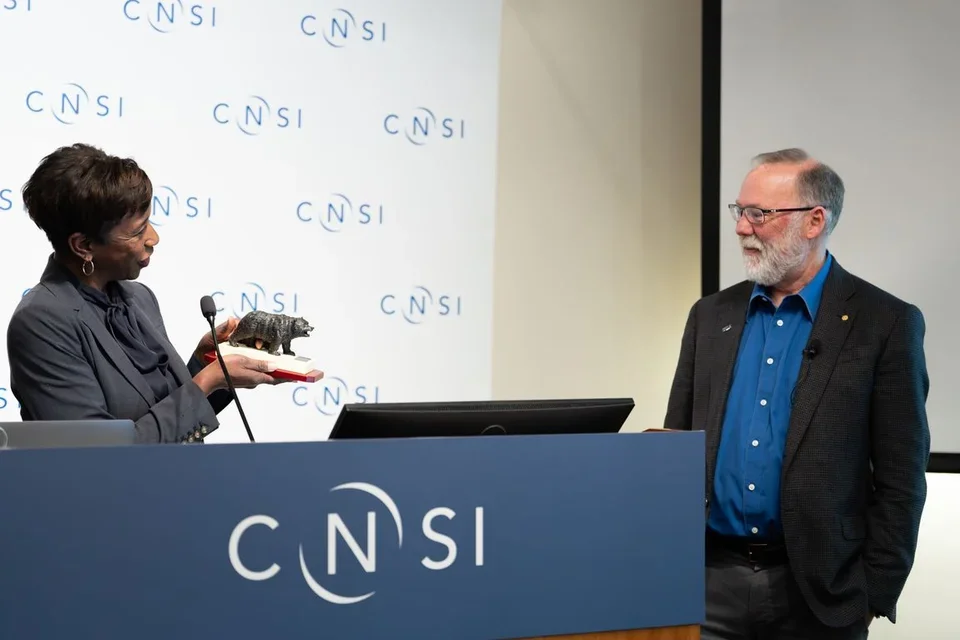
Photo Credit: David Esquivel/UCLA
When Tracy Johnson, UCLA’s dean of life sciences, came to the podium to close the program, she reflected on the culture of inquiry that defined Ramsdell’s career. She then presented him with the Bruin Bear Award from the hosting department, a commemorative plaque honoring both his Nobel Prize and his enduring ties to UCLA.
“You’ve shown that the pursuit of blue-sky science, driven by deep curiosity and interest in understanding the how and the why, can truly change the world,” Johnson said. “At a time when there are questions about the impact of fundamental research, you’ve given us a sense of how profoundly it can shape the way we think about science and medicine.”